
Next Generation of LED Ultra-Power Efficient and Razor-thin Signage” Lights
Through its pioneering use of materials, optical architecture and light source couplings, Visus offers energy efficient, low-profile, cost-effective and versatile world's first family of Flat Illumination Device (FIDs) for a variety of applications transcending the limits of traditional illumination.
Setting New Industry Standards:
-
Power Efficiency: x50 -100.
-
Power Consumption: From W down to mW.
-
Number of LEDs: x5 -10. From 4 -15 to 1 - 4
-
Thickness: x10 – 100. From mm to microns.
-
Weight: x5 – 10. From kg to gr
-
Cost: just give us a call:
Touching The Bottom.
No, that is not a value of our shares in today turbulent stock markets. This is a plummeting power consumption, size and cost of new lighting products from our high-tech pipeline.
Fully Qualified
Along with commercial products Visus is also a leading supplier of LCD backlights and other lighting products for military & industrial and other special purpose installations. As a rule all our products & components undergo advanced MILSPEC testing. The test platform for our LGP used a rugged edgelit device as a test vehicle. The devices were subjected to sever qualification tests - AFM (Advanced Failure Mode) customized to the public safety environment. This included shock, drop, vibration, humidity, sand and high temperature (90 deg C) operation cycles, most of which go far beyond commercial standards.
The Visus Advantage
Visus Photonics has introduced new ExFractor™ LED-based edgelit and facelit high-brightness signage products that offer exceptional thinness of 0.2 to 0.4 mm – much thinner than the slimmest existing 4 – 10 mm light guides - for a wide range of signage and general lighting applications. Reduced thickness and flexibility maximizes the advantages provided by the latest advances in LED technology and sharply increases manufacturing throughput.
Visus delivers light satisfying the most stringent demands of LCD and signage designers to bedazzle the consumers, while dramatically slashing costs and allowing a far lighter and compact products. Many years of optical, material and manufacturing research have culminated into this patented breakthrough family of products.
New backlight technology is disruptive in a number of major aspects:
-
Ultra-thin Multilayer LGF/LGP are manufactured by continuous extrusion process similar to optical fibers/films and roll to roll micro-embossing and offer a throughput undreamed of with conventional molding. They are in line with a latest LED miniaturization with 0.2 mm SMT devices already available.
-
New LGF backlights are scalable for different LCD formats: standard strip modules can be used for displays of different size.
-
Reduced number of LEDs - from 4 -15 to 1 – 4
-
Power Efficiency improvement by a factor x50 -100 - from W down to mW
-
No light pollution - Light is emitted to “Your Eyes Only". No Spillage to a Ceiling, Wall or Night Sky
-
Suitable for immediate retrofitting of your existing edgelit and cavity products.
-
Flexible, Bondable, Bendable. Special optical and material properties of new LGF allow its use with flexible LCDs and to laminate/bond it to any substrate (including a black one).
-
A combination of three patented VISUS core technologies has been indispensable for a development of a new product family:
-
HOW™ Hybrid Optical Waveguides with unique optical architecture
-
ExFRACTOR™ extractor technology ensuring uniformity with reduced LGF thickness
-
FoCoupler™ LED compact optical couplers to collect LED radiation and inject it into LGP
-
Functional Flat Fiber (FFF) developed in cooperation with Visus’s strategic partner
Maintenance & Installation
Our unique edgelit multilayer lightguide is basically different from a common PMMA plate. It represents a planar analog of a well-known cylindrical optical fibers used in telecommunications and some lighting applications. It has a number of key practical benefits:
-
Enhanced handling & scratch & dust & humidity & UV resistance. Legacy high end $150 edgelit signs invariably feature “crystal clear” “diamond cut” acrylic lightguides. A problem is that they are installed in anything but “crystal clear” environment. Any scratches, dust deposition (and who cares to clean them), water drops produce uncontrollable leakage of light reducing sign luminance and its contrast with immediate background and hence its visibility. Our FFF is free of all mentioned shortcomings, as the light propagates inside an optically protected “core”.
-
Off-socket Operation. Most off the safety signs can be furnished with a low cost photovoltaic Si cell and operate off-socket,
-
Ideal for outdoor applications – no degradation under rain, strong UV radiation.
-
Our LGP (LGF) can be directly bonded or laminated to any metal or plastic substrate of any color including BLACK without seriously degrading its optical performance. Can simplify mechanical mounting directly on walls, doors etc.
-
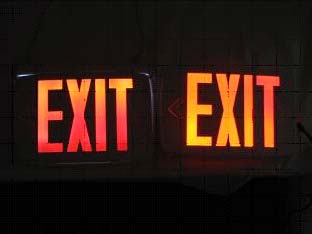
Can be used for simple retrofit of older devices. Fig. shows our 0.4mm thick sign just inserted into a low cost unit without dismantling any of its inner components. Power reduced by ~100 times.
-
Better Visibility in turbid media (smoke) due to more collimated output.
Signage Lighting: Incredible Energy Waste
With a recent progress of LED powered SSL devices one could hardly believe this harsh statement. Nonetheless let us face the facts by addressing a simple basic question:
Limits of Growth (efficiency): How far state of the art products are from an Ideal LED signage lighting device??? (Sure you remember that any problem’s solution starts with asking an intelligent question). You wouldn’t find a definitive answer to this question in a sea of professional literature. One can consider a typical EXIT sign as an example. Our trade secret:: you do not have to buy our $50,000 Optical CAD/CAM KEREN software to find out an answer. Neither one should be a distinguished professor like most of our R&D; staff at Visus are. (One should just be a concerned individual with a vision and irresistible urge for innovation and betterment of the world we all live in.) My pocket calculator tells that one lumen is required to produce a standardized lambertian (equal in all hemispherical directions) luminance of 15 nits. Since our sign is observed only from the lower quadrant (as in most cases there is no human observers hanging over a ceiling) this figure can be reduced by half to 0.5 lm. Now a tiny 0.3 mm thick low cost ($0.03 - 0.05) 65mW color LED has 1.5 lumens with best white LEDs emitting 7.5 lm. Let us be not overoptimistic: there are some irreducible losses, in particular, if we want to keep the costs low. Assume an overall output efficiency of 70%.
Good News: 5 - 20mW is needed to produce a sign in a variety of colors, which would satisfy a most demanding code of practice.
Bad News: The useful output of best available devices is 0.2% - 1% of installed lumens.
Something is terribly wrong in a photon supply chain of the best ubiquitous devices: as a paraphrase of an old saying goes: photons “hit a fan” somewhere on their way from LED chip to our eye turning our signs into almost perfect black holes.. As in many other cases of energy waste it is not only wasted fuel. It is also lighting pollution and added cost & energy & pollution of manufacturing redundant LEDs, unnecessarily thick acrylic light guides, poisonous batteries etc.
Read more...


