LED Primary Optics

FoCOUPLER™ Foconic Optical Couplers for LEDs.

It all starts at a chip…

Development of efficient high-brightness LED light sources involves fundamental studies of emission mechanisms in ZnS- and GaN-based wide-bandgap compound semiconductors. While internal quantum efficiency (i.e. electron to photon conversion)has been constantly improving external quantum efficiency continues to remain appallingly low, so that 50 – 90 % of a generated flux is trapped and absorbed inside a chip. Realization of illumination sources and fixtures for general market using LEDs calls for a significant improvement of EQE..
Visus Photonics achieved  a significant progress in developing realistic practical designs based on the innovative concepts of LED chip design and EQE (or simply Extraction Efficiency) conserving optical architecture by considering both optimal chip shape (mesostructures) and encapsulant primary and secondary optics.
Unique Foconic volume and EQE conserving couplers are integrally formed with LED as its primary optics replacing a conventional encapsulator lenses. Focon is a complex compound elliptic-hyperbolic conical section with a minimal thickness approaching a theoretical limit. Special math apparatus based on Light Field Theory has been developed to generate these smooth surfaces by our optical SW KEREN ™.

  1. New foconic FoCOUPLER™optocouplers ensure brighter LED with higher EQE with a thinner die structure meaning less expensive and more efficient chip and, not less important more compact and effective lamp size, e.g. more compact secondary optics;
  2. Design of Dye configuration, Primary and secondary LED Encapsulant Optics are intimately intermingled to produce an optimal lamp package. With a coupler optics tailored to a given chip and particular application one can attain the most effective solution. Unfortunately, it is often not the case, as many chip makes do not fully realize all practical implications, which the latter has on an end product and prefer standard less effective encapsulation design, if any.
  3. Foconic couplers have also a second major function: adaptation of an inherently lambertian intensity distribution of an LED to a particular application. Thus LED can turned into a side-emitting type allowing more uniform BLU.

Figure 1. Foconic volume and EQE conserving CRATER™ coupler with an ejection aperture restricted by TIR angles. Optimal for LEDs coupled to large lightguides with extractors (BLU, large planar sources). Generated by our optical SW KEREN ™. Actual Scale.
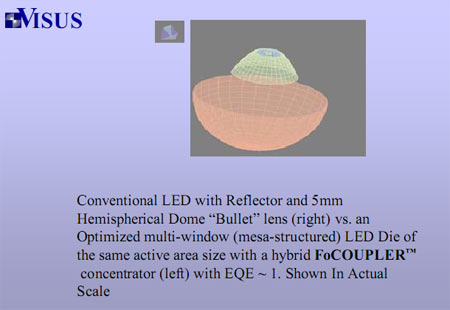
Figure 3.  Example of CPC-like foconic microlens producing maximal flux collimation and EQE.

Figure 4.  Controlled roughening of LED die improves EQE

Read more...


Extractorless Light Guides

Two Dimensional Volume Conserving Extratorless Non-Linear Wedge (NLW) Light Guide Panels For BLU and FID

Another World's First From Visus! 

Key Advantages:

  • No need for distributed micro-extractors.
  • Available in any size and aspect ratio
  • Greatly Reduced NRE & Production costs.
  • Higher Yield & Repeatability.
  • Up to 1.75 times higher luminance at a given thickness.
  • Up to 70% lower Weight & Volume.

Fig. 1.  Non-Linear 1D Wedge (NLW) LGP produces uniform luminance without any light Extractors. It is also 25 – 50% lighter compared to planar and linear-wedge LGPs.

Uniform light extraction can be effected by accurate control of LGP’s tilt, i.e. curvature. Obviously this method has key practical benefits compared to conventional distributed micro-extractors. However a complexity of calculating such a surface has been a major hurdle preventing its practical use. Indeed special flux transfer computational methods and lens synthesis software had to be developed to solve the problem.
Two-dimensional non-linear wedge LGP has a generally smooth concave shape and is thinnest at one point (resembling an aspherical concave or plano-concave lens). Since generally X and Y dimensions are not equal and lamps generally are coupled only to some of the edges the wedge has no axial symmetry. It represents a special and unique optical element (system) which can be termed Aspherical Asymmetrical Edge Lens (AAEL). If the lamps are disposed symmetrically about the edges of the polygonal plate, the thinnest point will be at the center; most of the forward propagating flux from each individual lamp toward the center is then incident on a concave surface with negative slope and is gradually extracted out. This surface has a key volume conserving property:  a concave shape minimizes to a theoretical limit the volume and thus the weight, of the plate (consistent with the edge width necessary to efficiently couple light from adjacent lamps).

Fig. 2.  Two sided Non-Linear 1D Wedge with two CCFLs coupled to opposite edges.

Fig. 3. Four sided Non-Linear 2D Wedge. LEDs are mounted along all four edges. It has 3.5 times higher luminance and is 50-75% lighter compared to one sided planar LGP.  For the same luminance thermal management is much better, since a given number of LEDs is mounted more uniformly along all edges.

Fig. 4. Two sided Non-Linear 2D Wedge. LEDs are mounted along two edges. It has 1.75 times higher luminance and is 50-75% lighter compared to one sided planar LGP

Read more...


Functional Flat Fiber

Re-inventing LGP: Functional Flat Fiber (FFF) With Microprismatic Exfractors™.

In cooperation with one of its manufacturing partners Visus has developed unique 0.1-0.2mm FFF lightguides (also referred as LGF – lightguiding film), which will fundamentally change backlighting technology by producing BLU with a thickness of a customary optical film. These new BLU are ideally suited for LED lamps undergoing rapid miniaturization.
FFF multilayer lightguide is basically different from a common PMMA plate. It represents a planar analog of a well-known cylindrical optical fibers used in telecommunications and some lighting applications. It has a number of key practical benefits:

  • With a thickness of just 0.1 – 0.4 mm FFF can be effectively coupled to the latest HB ultra-compact SMT LEDs and reduce device profile & weight. Customary compression molding is relatively slow and cannot produce less than 0.4 – 0.6 mm thick LGP.
  • FFF with a light Extraction micro-array is manufactured by a continuous (roll to roll) high performance microreplication methods (5 – 50 m/s) drastically reducing manufacturing cost & time. Millions FFF can be produced within a few shifts.
  • Higher collimation around Line-Of-Sight.
  • Flexible. Can be used in future flexible LCDs.
  • FFF can be directly bonded or laminated to any metal or plastic substrate of any color including BLACK without seriously degrading its optical performance. Can simplify mechanical mounting directly on walls, doors etc.
  • Enhanced handling & scratch & dust & humidity & UV resistance. Any scratches, dust deposition, water drops produce uncontrollable leakage of light reducing BLU luminance. Our FFF is free of all mentioned shortcomings, as the light propagates inside an optically protected “core”.
  • Ideal for outdoor applications – no degradation under rain, strong UV radiation.

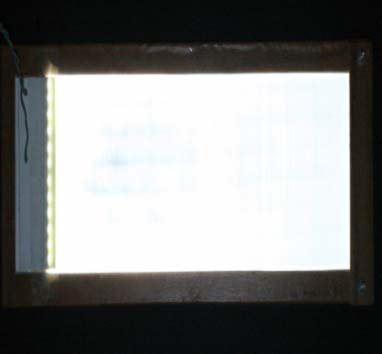
Figure 2.    Enlarged image of 0.2mm modular FFF with uniform luminance. Dot size 30-50um.

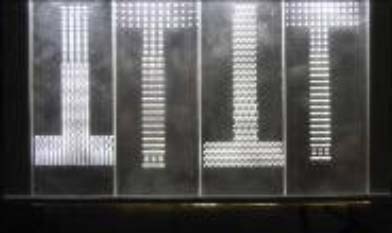
Figure 3.  FFF with letter “T” for EXIT sign with directional microlens extractors.

Read more...


HOW Hybrid Optical Waveguide

HOW™ Hybrid Optical Waveguides: Fundamentally New Optics for Ultra-thin Lighting Systems

Patented Hybrid Optical Waveguide (“HOW”), represents a new generic compound class of systems with functionally distinct cooperatively acting optical entities. These include: 

  1. Principal Radiation Carrier (PRC); 
  2. An extended planar or wedge Waveguide Ejector with distributed flux extraction means termed Hybrid Optical Pipe Ejector (HOPE); 
  3. Distributed Optical Pipe Ejectors (DOPE) with directional flux ejection properties; 
  4. Distributed Optical Pipe Injectors (DOPI).  

The HOPE, DOPE and DOPI are also referred to herein as Secondary Radiation Carriers (SRC). Depending on geometry and coupling architecture of these entities HOWs can be configured to perform a variety of functions related to transfer, distributed injection, and distributed directional ejection of a radiant energy.  Some combinations of PRCs and SRCs are described below: 

  1. PRC – Planar waveguide ejector referred to hereinafter as a Hybrid Optical Pipe Ejector (HOPE);
  2. PRC – DOPEs providing distributed discontinuous (localized) quasi-lambertian or directional flux ejection over the whole length of PRC;  
  3. PRC – DOPIs providing distributed flux injection over the whole length of PRC; 
  4. Doubly Hybrid PRC – DOPIs/DOPEs providing distributed flux injection and ejection over the whole length of PRC; and
  5. Multiple active and passive PRCs-SRCs providing distributed flux injection and ejection through PRC apertures.

Ultra-thin HOW™  Backlight PRC – HOPE configuration. Thickness of HOPE lightguide can be x10 and smaller than a size of coupled LED.

Read more...


Information

Prototypes, POCs and small batches of high performance products are manufactured in-house. High volume production is carried out by ISO 9001:2000 certified high-tech manufacturing partners of Visus Photonics in Korea and USA.

Visus has strategic manufacturing agreements with a number of leading US and Korean manufacturing partners with an expertise in mass production of micro and nano-optical systems and exclusive optical materials.